
Overhead Tank vs Underground Sump Cleaning: Key Differences Explained
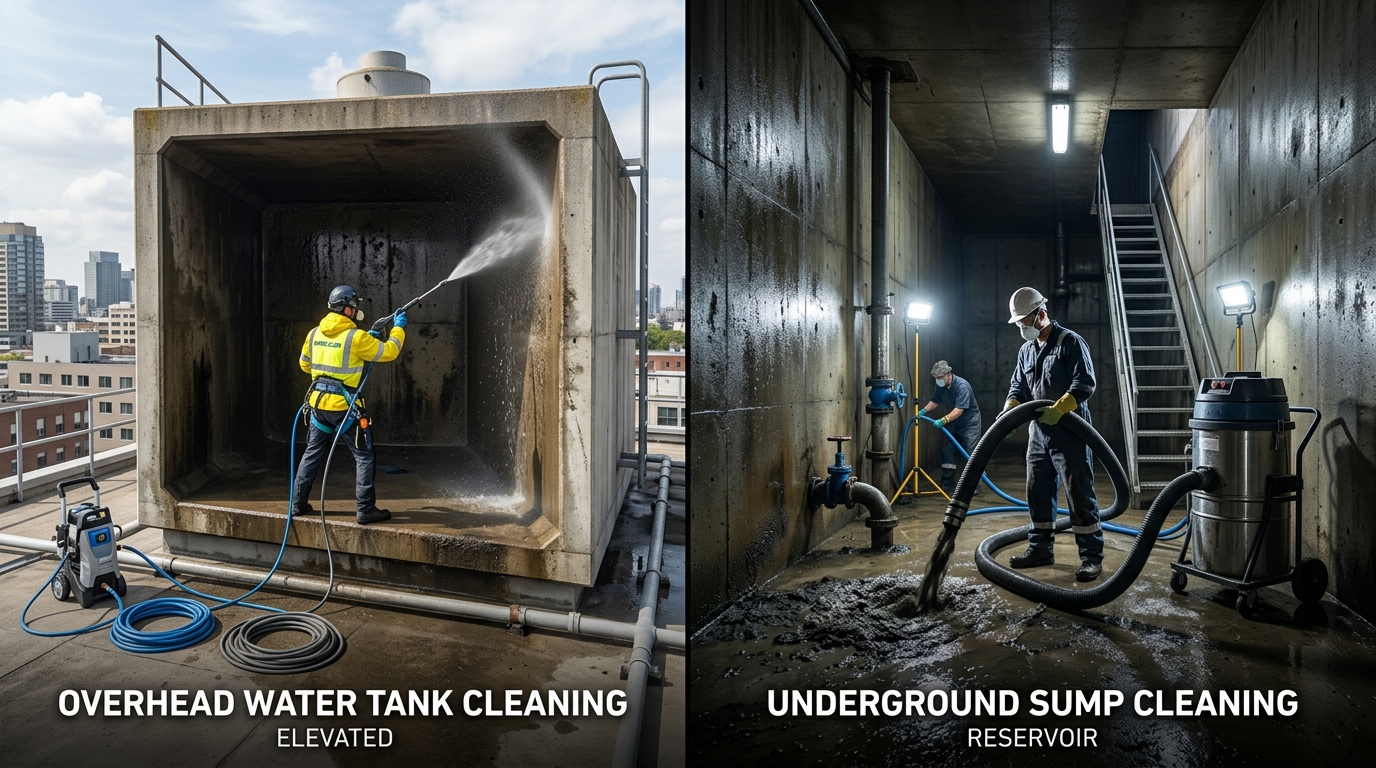
In almost all residential buildings, villas, and apartment complexes in Hyderabad, the water infrastructure follows a two-stage storage process:
- The Underground Sump: First receives incoming municipal water or borewell supply at ground level.
- The Overhead Tank (Rooftop): The sump pump pushes water up into overhead Sintex plastic or RCC concrete tanks, from which water gravity-feeds into taps.
Many property owners assume that both storage units are virtually identical and can be maintained using the same methods. In reality, overhead tanks and underground sumps are fundamentally different ecosystems with distinct structural materials, bacterial threats, and safety risks.
1. Contamination Dynamics: How They Differ
Underground Sump: Silt Accumulation & Seepage
Because sumps are located below ground level, they act as primary settlement basins:
- Heavy Mud & Sludge: Heavy sand grains and soil particulates sink immediately to the sump floor, often forming a 3 to 6-inch sludge bed within months.
- Groundwater Infiltration: Concrete sumps are vulnerable to microscopic fractures. During rainy seasons, surface runoff contaminated with soil bacteria and drain overflow can seep through porous concrete.
- Lack of Sunlight: While darkness prevents green photosynthetic algae, it encourages bacterial biofilms, sulfur-reducing bacteria, and mold.
Overhead Tank: Heat, Algae & UV Degradation
Perched on the terrace, overhead tanks (especially black or colored Sintex plastic units) endure relentless sunlight and ambient heat:
- Rapid Algae Growth: Intense rooftop sunlight warms water to 35°C–45°C in Hyderabad summers, creating the perfect greenhouse for rapid algae blooms.
- Thermal Expansion: Constant temperature swings cause plastic or concrete to expand and contract, releasing micro-flakes into the water.
- Airborne Dust & Insects: Wind carrying rooftop dust, bird droppings, and leaves can enter through ill-fitting vent pipes or lid edges.
Crucial Warning: Confined Space Hazard
Entering an underground concrete sump is classified as a hazardous confined space operation. Decaying organic sludge produces toxic gases like hydrogen sulfide (H2S) and methane. Untrained workers must never enter a sump without forced ventilation and safety gear.
2. Mechanized Equipment Required: Direct Comparison
| Cleaning Stage | Overhead Rooftop Tank | Underground Concrete Sump |
|---|---|---|
| Dewatering | Submersible pump with roof drainage | Heavy-duty high-head dewatering pump |
| Sludge Removal | Wet & dry vacuum extractor | High-volume industrial slurry suction |
| Wall Scrubbing | Regulated pressure jet (protects PVC) | High-pressure rotary jet (150–200 bar) |
| Disinfection | Antibacterial spray + UV lamp | Deep antimicrobial fogging + UV lamp |
3. Which One Should You Clean First?
Many homeowners ask whether they should clean the overhead tank or the underground sump first. At Yamuna, our protocol follows the Sequential Clean Rule:
- Always clean the Underground Sump first: If you clean the rooftop tank while the sump still contains 4 inches of mud, the moment your motor pump turns on, it will pump dirty slurry straight into your freshly cleaned rooftop tank!
- Flush the connecting pipes: Run clean water through the riser pipe to clear line silt before refilling the overhead tank.
- Clean the Overhead Tank: Now that the source is pure, sanitize the overhead tank and gravity down-lines.
Why Choose Professional Mechanized Services?
Attempting to clean either tank with local manual laborers using brooms and buckets is not only unhygienic, but it can also scratch the anti-algal inner coating of your Sintex tank or fail to remove the toxic sludge layer in your sump.
With Yamuna's mechanized 6-stage cleaning service, our trained Banjara Hills team brings specialized German pressure equipment, slurry vacuums, food-grade antimicrobial sanitizers, and portable UV-C radiators to guarantee zero contamination and absolute water purity.